How Google’s December 2025 Core Update Improved Web Navigation Experience
The article analyzes Google’s December 2025 Core Update, highlighting its impact on search rankings through improved evaluation of content quality, relevance, and user experience. While it does not directly affect page load performance, it reinforces the growing importance of real-world user experience in Google’s search ecosystem.
TECHNOLOGYUSER EXPERIENCE
Juan Fleitas
5/8/20242 min read

In December 2025, Google rolled out a major Core Update aimed at improving search quality and overall user experience. While core updates are not designed to directly modify page delivery or network performance, they can significantly influence how content is evaluated, ranked, and ultimately served to users, with tangible effects on how the web is experienced.
This article addresses a key question:
What is the impact on web browsing experience following Google’s December 2025 updates?
To answer it, I reviewed the official analysis published by ALM Corp and complemented it with a real-world performance analysis across multiple LATAM countries, focusing specifically on page load time and web experience on Google-served traffic.
What the December 2025 Core Update Focused On
According to ALM Corp’s analysis, the December 2025 Core Update primarily targeted:
Content relevance and usefulness
Better alignment with user intent
Reduced visibility of low-value or redundant content
Stronger weighting of real user experience signals
Importantly, no direct changes to page loading infrastructure or network behavior were announced. From a theoretical standpoint, page load time should remain unchanged. However, real-world data tells a more nuanced story.
What We Observed in LATAM: A Clear Before-and-After
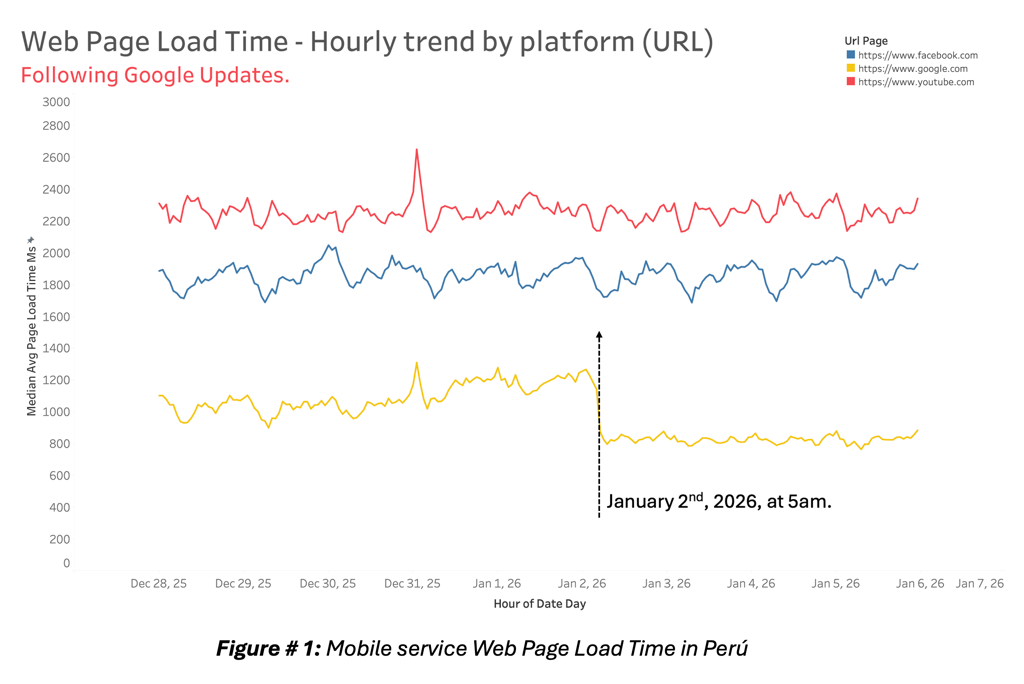
As part of a preliminary analysis, I reviewed hourly median page load time trends across several LATAM markets, comparing periods before and after January 1st, 2026.
Consistent findings across countries:
Page load time improves after January 1st, 2026
Web Score improves accordingly, reflecting better perceived performance
The improvement is observed only on Google
Other platforms (e.g., Facebook, YouTube) do not show the same shift
The timing aligns closely with the stabilization phase following the December 2025 Core Update.
The chart highlights a clear inflection point:
A sharp and sustained drop in median page load time for Google traffic starting January 2nd, 2026 (around 5 a.m.)
Stable behavior before that point
No comparable improvement on non-Google platforms
This strongly suggests an algorithmic, platform-specific effect, rather than changes in network conditions or infrastructure.
Why This Matters for Web Navigation Experience
Although the update does not directly optimize page load time, it appears to indirectly enhance browsing experience in several important ways:
1. Smarter Content Selection
Google may now prioritize pages that:
Load more consistently
Deliver meaningful content faster
Avoid heavy scripts and unstable layouts
As a result, users are more likely to land on pages that feel faster and smoother.
2. Reduced Exposure to Poor-Performing Pages
Websites with weak performance characteristics: slow rendering, excessive client-side execution, or layout instability; may lose visibility, reducing their presence in search results.
3. Improved Perceived Performance
From a user perspective, what matters most is not raw network speed, but how fast a page feels. The post-update trend suggests Google is surfacing content that delivers a better end-to-end experience.
Did Google “Make the Web Faster”?
Not directly. However, Google did improve how users experience the web by:
Re-ranking content using stronger experience signals
Favoring pages that load and behave more efficiently
Indirectly penalizing poor performance through reduced visibility
For end users, the outcome is straightforward:
Pages load faster, navigation feels smoother, and search results lead to higher-quality experiences.
Final Takeaway
The December 2025 Google Core Update illustrates how search algorithms can materially influence real-world user experience, even without changing page delivery mechanisms or network speed.
For publishers, businesses, and regulators, the takeaway is clear:
Page performance and user experience are now central to visibility
Search rankings increasingly reflect how well pages behave for real users
Monitoring page load time alongside search performance is essential
Google didn’t just update its algorithm, it quietly raised the bar for what good web navigation looks like.
© Copyright Juan Fleitas 2026. All rights reserved | Privacy Policy | Terms and Conditions | Home | Consulting Services | Blog | Contact Us |